
When Google sneezes, the search world catches a cold. And, savvy business owners? We start prepping the medicine cabinet.
In an earlier blog we talked about the rise of Google AI Search. Now we take a close up look at Google’s latest experiment, Web Guide, is more than just a shiny new feature. It’s a glimpse into the future of search – and a wake-up call for anyone still clinging to outdated SEO tactics. If you’ve been cruising on keyword stuffing and hoping for the best, this one’s for you.
What Exactly Is Web Guide?
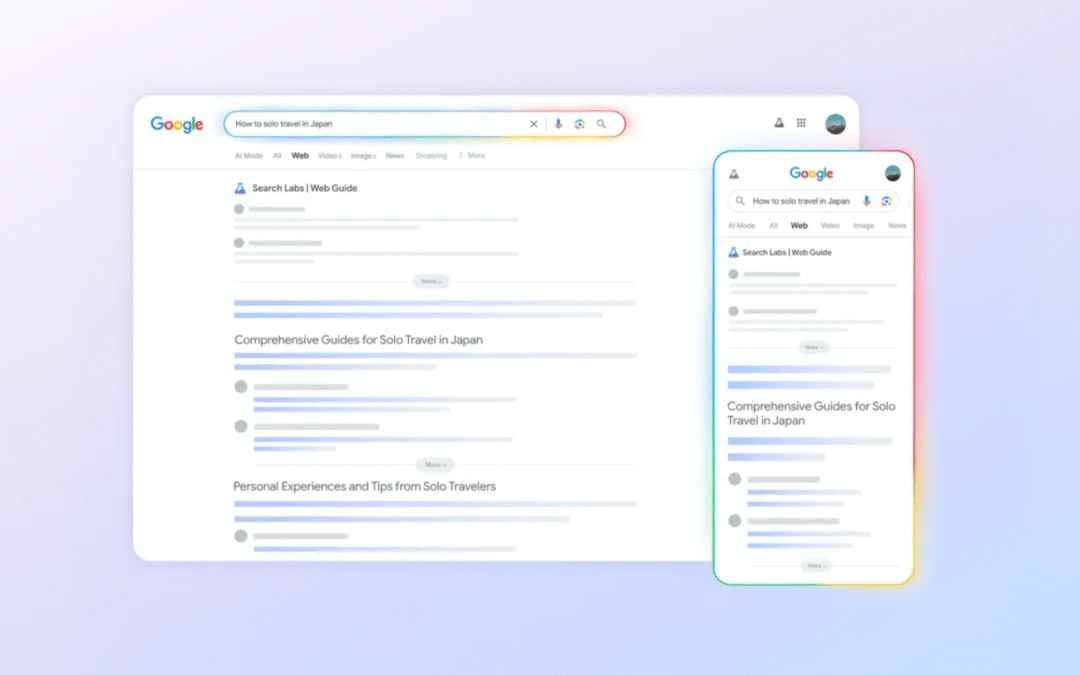
Web Guide is part of Google’s Search Labs, and it’s powered by their in-house AI (a custom version of Gemini, if you’re curious). Instead of the traditional wall of blue links, Web Guide clusters your search results by topics. Think: subcategories, summaries, and cleaner navigation all wrapped in a neat little AI-powered bow.
Let’s say someone searches “solo travel to Japan.” Instead of 10 mixed links, they’ll see a clean layout with sections like Transportation, Accommodations, Local Tips, and more. It’s not just easier on the eyes—it’s faster and more intuitive for users.
You can turn it on under the “Web” tab in Search Labs if you’re into experimenting, and you should be.
Why This Matters Right Now
Every major change in how Google serves results – think Featured Snippets, AI Overviews, People Also Ask – started as a test. And spoiler alert: they didn’t stay experimental for long.
Here’s the kicker: Web Guide favors websites with topical authority. If your content is scattered, shallow, or hard to navigate? You’re already behind. But if your site is structured, organized, and brimming with relevant content that covers key themes deeply and clearly? You’re golden.
Translation: Google is no longer just looking for keywords. It’s looking for context, clarity, and comprehensive coverage.
What You Should Do (Starting Yesterday)
If you want to show up in Web Guide’s AI-curated glory, here’s your game plan:
1. Build Topic Clusters Like a Pro- Organize your content around “pillar” pages that address broad themes (e.g., “Planning a Trip to Japan”) with supporting subpages (like “Best Bullet Trains,” “Solo Travel Safety,” “Packing Essentials”). Google loves structure—and so do your readers.
2. Boost Internal Linking – Help both humans and AI crawl your content easily. Link related articles with intentional anchor text that guides the journey. It’s SEO glue.
3. Use Headers and Structured Data- Break up content with clear H2s and H3s that mirror real search intent. Add schema markup where relevant to help Google really understand your content.
4. Stay on Top of Search Experiments – Keep tabs on what’s rolling out in Search Labs and the Google blog. Features like Web Guide often go from “beta” to “standard” in the blink of an algorithm update.
Final Take: Authority Wins the Race
At Obsessed With Success, we’re already building SEO strategies with Web Guide in mind. This isn’t about chasing every trend—it’s about preparing for what’s next so you don’t get left behind.
You don’t need to be an SEO wizard to make this work – you just need a smart content structure, a strategy-first mindset, and a little guidance. That’s what we’re here for.
Ready to future-proof your content and lead the pack? Let’s connect and build an authority-first strategy that has Google (and your ideal customer) saying yes, please.


